In a paradigm where urgency culture is pervasive, taking things a bit slower can be very uncomfortable. Urgency culture makes us feel compelled to do things quickly and immediately1. It also puts pressure on us to be constantly switched ‘on’, resulting in overpacked schedules. It may often leave us feeling overextended and neglectful of our own need for care.
And while urgency culture might be assumed to boost productivity, it can hinder it. Rushing might prevent deep work and diminish time for creative problem-solving. For example, when under pressure to act quickly, individuals may make rash decisions without considering the potential consequences, or they might not take the time to build trust before having difficult conversations. Urgency culture also blurs the lines between work and personal life, making it difficult to disconnect and recharge. It is therefore not uncommon for us to feel stressed, overwhelmed, anxious, burnt out, or battling chronic health issues.
Moreover, because urgency culture has become normalised, our participation in it is mostly unconscious. As a result, we may fail to question whether many situations are in fact urgent, or whether our sense of panic might prevent us from thoughtful prioritisation. This tendency might become so internalised that the need to slow down, to prioritise, rest or just be present, might fill us with frustration and angst.
Before I consciously started resisting urgency culture, whenever I encountered people who moved like ‘tortoises’, I felt frustrated at being held back. However, once I realised that my urgency was often driven by internalised systemic drivers of productivity, I began to recognise those moments when I needlessly tried to push things forward, speed up, or just irritably champed at the bit. This awareness enabled me to pause and slow things down. As I started relaxing, I was able to reassess the situation with curiosity, neither judging myself nor others for how we were showing up. Furthermore, in slowing down, I was able to ask more questions, thus learning more about myself and the process than when I was showing up as a proxy for urgency culture.
A deep dive into urgency culture
So, where does urgency culture come from and who does it benefit? Who told us that we can win the game if we just work harder, put in more time, and strive for more?
Colonialism, white supremacy and capitalism are all interconnected. Similarly, our complex relationships with urgency and slowing down emerge from unique intersections between these oppressive systems and our own contexts and identities.
Let’s start with colonisation and how it affected our relationships with time2. It is important to recognise that the history of colonising land was inseparable from colonising patterns of timekeeping and temporal understandings. As a result, we have largely forgotten the wisdom of ancient cyclic calendars and other temporal technologies. We have learnt to disassociate time from the nuance of place. We’ve come to think of time as linear, believing that we only have one opportunity to get something right. This strengthens white supremacy characteristics3, including fear, urgency, “progress is more”, and “one right way”. Capitalism is rooted in practices that dehumanise and exploit people for profit. It does so by teaching us that time is money and that our value lies in our ability to use time to produce, earn and spend. As a result, we are pressured to justify our worth and existence through output and productivity, which in turn leads to urgency, shame and “grind culture”.
Urgency culture functions as a norm that reinforces these paradigms as well as the power imbalances they uphold. In this way, it undermines liberation and meaningful connection. When we are constantly in motion, always feeling behind, and in a state of overwhelm, when slowing down is considered as resting, and resting is seen as preventing us from delivering the goods, and… we start to work under a constant sense of the need for urgency. Everything we encounter becomes an emergency. This, in turn, leads to our bodies and minds feeling triggered, hypervigilant, and under constant pressure to perform, confront, or escape. Moreover, we lose the ability to experience curiosity, playfulness, care and collaboration. This constant state of being in motion undermines the practice of inclusion and more thoughtful and compassionate ways of participation.
For example, we allow urgency culture to reign when we focus on reacting and doing, rather than creating space and asking open questions, such as “In this situation, is urgency really needed?” or “What is fueling our urgency in this moment?” Furthermore, we accept production, quantity over quality, and settle for the promise of ‘next time’. “Next time, we’ll invite those communities. Next time, we’ll include you in the conversation about your work. Next time, we’ll consider accessibility needs.” In the process, we miss the opportunity to act from our values and to work steadily and with care. When our decision-making does not extend beyond what we do and produce, the bigger questions of equality, justice and liberation fall by the wayside.
That is why it is important to distinguish between true urgency (the moral imperative for racial justice) and manufactured urgency (the fast-paced, short-term, profit-driven rush that serves oppressive systems). The paradox is that only by slowing down are we able to be present with ourselves and one another in ways that allow our methods to align with our values, rather than reproducing the very systems we’re trying to dismantle.
So, how do we pivot? How can we access the wisdom needed to consciously choose ourselves, our community and our humanity?

Wisdom from the tortoise as an antidote to urgency
“I think that allowing ourselves the ability to really change how we see things is how we’re going to change things.” – Dahr Jamail, We Are the Middle of Forever: Indigenous Voices from Turtle Island on the Changing Earth.
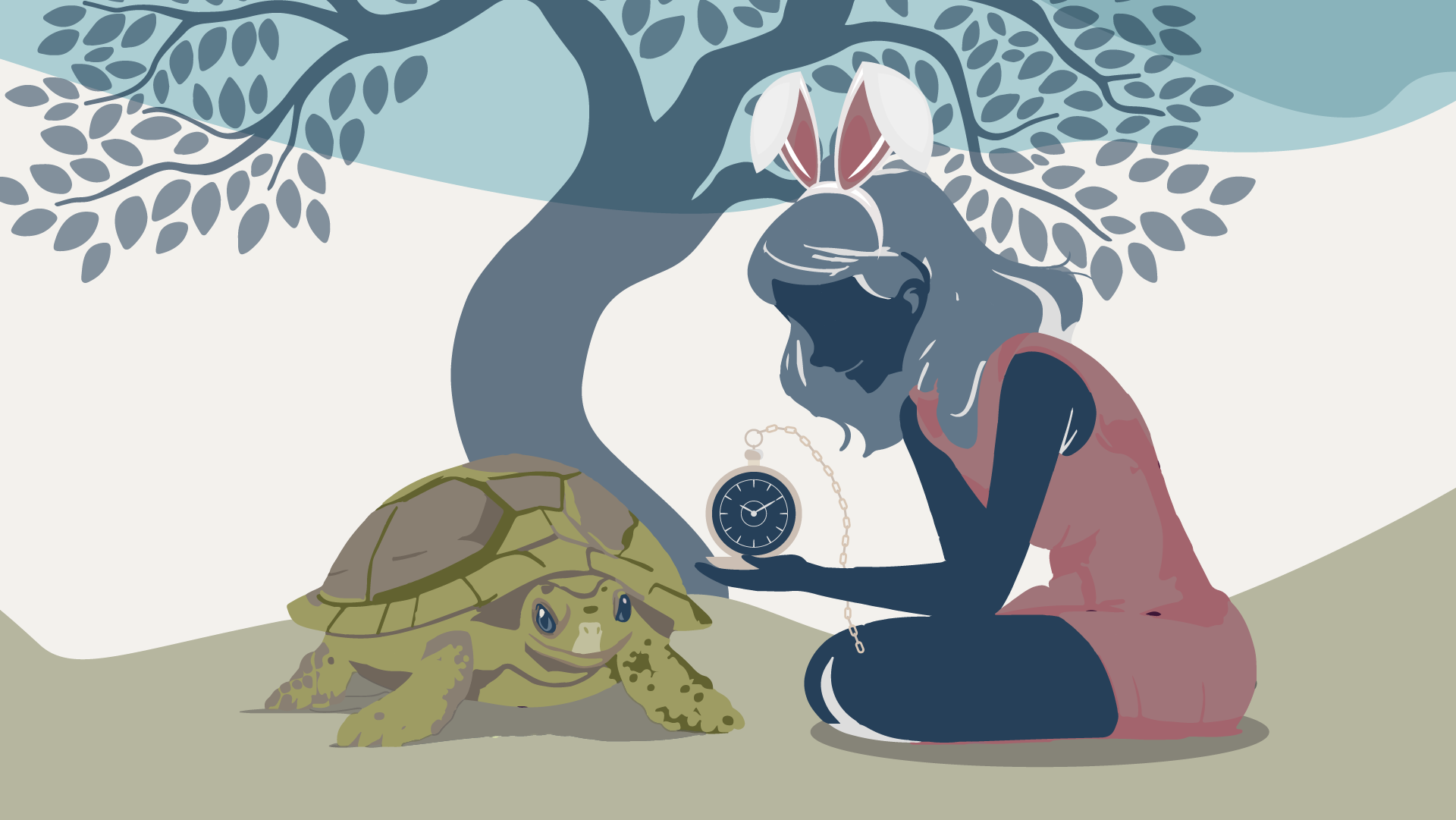
In the story of the Tortoise and the Hare, the tortoise is depicted as a slow-moving creature that succeeds using the principle of steadiness. To move like a tortoise means taking the time to learn and hone our skills at slowing down. The tortoise knows that starting “a journey of a thousand miles begins with a single step”. This wisdom allows us to acknowledge that the transformation we seek takes time. We can do it if we are willing to take one step, and then another, and another. We must learn to take the time to invest in ourselves and our ability to do better. This way of moving may be slow, but it’s worth it in the end. Instead of giving in to urgency, the tortoise shows us how to stick out our necks to take calculated risks and to move steadily forward to achieve our long-term goals.
Below are some of the lessons we can learn from the tortoise as we strive to transform our participation in an urgency culture:
#1: You are the change you seek
Often, our participation in urgency culture is either about maintaining a sense of control or about avoiding conflict. Yet, we need to ask ourselves, “What’s the impact of maintaining this control or avoiding this conflict?”
Like any instinct, tortoise instinct has its place and time. Stepping back from control allows our nervous system to reset, allowing us to move out of a reactive state and into a more thoughtful, regulated mindset. In moments of intense overwhelm, solitude can also create space for self-reflection, helping us process emotions, regain clarity, and decide on the best next steps; thus allowing us to re-emerge with greater clarity, resilience and readiness to engage.
At the same time, it is important to ensure that retreat doesn’t cascade into avoidance. When we retreat for too long, our challenges don’t disappear. Often they grow. Avoidance can also reinforce fear, making threats seem even more overwhelming. While temporary retreat can be helpful, long-term avoidance keeps us stuck. So, how can you counteract an overactive tortoise instinct?
Ultimately, we all need to learn how to establish clear boundaries to disconnect and prioritise our wellbeing. Take a pause when you start to feel the pressure of the day-to-day need for control or conflict avoidance. For example, you might find yourself feeling tired or overwhelmed, yet still think, “I have so much I need to get done, I can’t afford to stop now,” or “If I don’t get this done on time, I will be in trouble or lose support”.
When you notice these pressures, remind yourself that your urgency reflex might be driven by internalised systems of oppression and that giving yourself a few moments to reflect could allow you to disrupt this urgency culture in yourself and others. Allowing time to reflect on where the pressure you feel is coming from is useful. Ask yourself, “If I don’t get this done, who will it affect?” Then ask yourself, “Just because this feels like an urgent priority to me, is it the same for everyone else? Might it be okay to ask for an extension given the circumstances?” Once you get a sense of the true urgency of the matter, also ask yourself, “How might taking a small break to rest and reflect add to what I am doing rather than take away from it?” Allow your answers to challenge your deadlines and expectations. Perhaps, if it is needed and feels safe to do so, recalibrate and adjust your plan. If you decide that the right thing is to keep going, thank yourself for making the time to consciously choose.
#2: Seeing the long view vs speed and instant gratification
In our current reality, we often seek instant results. Like me, many of you might have been tempted by promises to help you make changes in 21 days, or 90. Tortoises, by contrast, understand that they are in it for the long haul. They do not feel the pressure to hurry to get to the outcome, but rather are content to move with the current as they progress to where they are heading. The power of this is that when we choose what we really, really want, it is grounded in the wisdom of our past experiences and what we truly desire, rather than what we are being fed by the capitalist systems we find ourselves in.
Assess how you have glorified busy-ness and reinforced urgency in your own life. A long-term view means creating space for and encouraging conversations about how busy-ness has affected your life. It means taking the time to revisit personal values and ask, “ What am I committed to in the long term, and how might instant gratification get in the way of that?” Then ask, “What might the alternative look like?”
#3: Practice makes perfect: Stick to your path
The second lesson from tortoises is that they stick to their path. Once they move in a particular direction, if someone picks them up and turns them in another direction, the tortoise will retreat into their shell. And once you move away, they will turn around and resume the path they had already chosen.
We humans, on the other hand, might more easily deviate from our long-term plans because when we feel threatened, we become more sensitive to rejection, shame or embarrassment. In this state, sticking to our path might feel risky. What if others criticise us? Similarly, as we share our dreams and visions, or even our obstacles, with others, those around us may try to protect us and, as a result, tell us to change our course. However, if we are guided by the way of the tortoise, we realise that we have to trust our own direction.
The value of this lesson also applies to how we consistently redefine productivity to include space, rest and reflection, and how we permit ourselves to go slow. Centring rest is a revolutionary act, one that goes against the status quo., We have to, therefore, be willing to keep making space for it, despite the urgency and pressure-based approaches of those around us. Even when we fumble, we have to stay the course, and we have to keep doing it until we have created an alternative paradigm.
#4: Go at your own pace
The movement seeks uniformity because uniformity and purity feel safe. This, too, is the language of trauma. Kai Cheng Thom from I Hope We Choose Love (p. 100)
I used to get very frustrated when viewing my progress against others’. However, over time, I have realised that my pace is perfect for me. Similarly, the tortoise doesn’t try to be the hare or to buy into the hare’s vision. The tortoise appreciates that the hare has a different process. Like the hare, the tortoise also has a vision or goal to cross the finishing line. In a white supremacy culture of “one right way”4, this is another simple truth we need to remind ourselves of over and over again. You can only assess your pace and progress against your own framework and your own path, not the path of anyone else.
#5: To move forward, you have to stick your neck out
Like all of us, the tortoise as an archetype has a shadow side, which may encourage us to pull into ourselves and hide, telling ourselves that things happen as they happen, and that we just need to continue going with the flow.
However, the true tortoise knows that to move forward, it needs to stick its neck out. It cannot make progress from inside its shell. As human beings, we have to recognise that, if we want change, if we want to set a new course, we cannot sit in our comfort zone hoping that circumstances will propel us forward, or that our environment or someone will push us forward. If we want to move forward with the things that matter to us, we have to stick our necks out. We have to stop hiding behind our fears. We have to take those leaps. As the saying goes, “It is better to try your best and fail than not try at all and experience regret”. When resisting urgency culture, as we try different things, unseen issues or intrapersonal challenges may arise, and we might feel tempted to ignore the need to slow down or take a break. This work, however, is important, so even when, at times, we feel compelled to respond to urgency, we need to show ourselves grace, take a breath and ask ourselves, “How might I take a calculated risk here to be one step ahead of urgency culture?”
#6: You have everything you need to succeed
The tortoise’s home is its shell. They never leave their home, but more importantly, their home never leaves them. They already have everything they need to survive and thrive. What this means is that anywhere we go, we have enough within us to move, to thrive, to grow. So often our excuses are just that, excuses. For example, we might tell ourselves that we do not have enough knowledge, money, courage, etc., to stay on our path or to take a risk. However, as we stay stuck in indecision, we forget our inner resourcefulness. Similarly, we have the capacity to take our time for activities that promote relaxation and reduce stress, too. We just have to trust our own resourcefulness, as well as the goodwill of those with whom we are in supportive relationships.
In conclusion, when we are exhausted and burnt out, we lack access to our gift to imagine, ideate, and create. A constant state of busyness keeps us from dreaming and dismantling oppressive, dehumanising systems. It’s harder to reimagine new ways of working and being together when we are constantly motivated to produce from a state of urgency and stress. Rest is therefore resistance, and slowing down is truly a radical, anti-capitalist practice. Tortoise wisdom reminds us to travel at our own pace, to slow down, enjoy the journey, and go with the flow, but also to trust our instincts.
1 – https://www.whitesupremacyculture.info
2 – Hunfeld, K. (2022). The coloniality of time in the global justice debate: de-centring Western linear temporality. Journal of Global Ethics, 18(1), 100–117. https://doi.org/10.1080/17449626.2022.2052151)
3 – https://www.whitesupremacyculture.info/characteristics.html
4 – https://www.whitesupremacyculture.info/one-right-way.html