Femicide in South Africa is not a private tragedy, a failure of individual morality, or the product of a single “bad man.” It is the lethal expression of a social order in which racial capitalism renders Black, working-class and poor women disposable, while patriarchy supplies the entitlement, control and impunity through which that disposability becomes violence.
In this powerful poster and accompanying analysis, Professor Salim Vally traces the connections too often severed in mainstream coverage: unpaid reproductive labour, apartheid’s spatial geography, precarious work and transport, hostile hostels and informal settlements, economic dependency, violent masculinities, and a state that repeatedly fails to protect those most at risk. From the mining compound to the township periphery, from weaponised custom to media narratives that reduce murder to “passion,” Vally shows how structures produce the conditions in which women are killed, and how those same structures then obscure accountability.
The urgency is undeniable. South Africa’s femicide rate stands at 9 per 100,000 women – five times the global average – and 957 women were murdered between July and September 2024 alone. In November 2025, gender-based violence and femicide were formally classified as a national disaster, a recognition that this is not a private family matter but a systemic emergency demanding structural response.
Vally’s intervention is especially necessary at a moment when opportunistic narratives seek to blame migrants, “foreigners,” or cultural pathology for femicide. This poster refuses that evasion. It insists that we look squarely at the intersection of racial capitalism and patriarchy: at whose labour is exploited, whose mobility is restricted, whose safety is neglected, and whose deaths are normalised.
Read it not as an explanation that excuses perpetrators, but as a map of the systems that must be dismantled if women’s lives are to be valued, protected and free.
Femicide is not inevitable. It is political. And it can be ended.
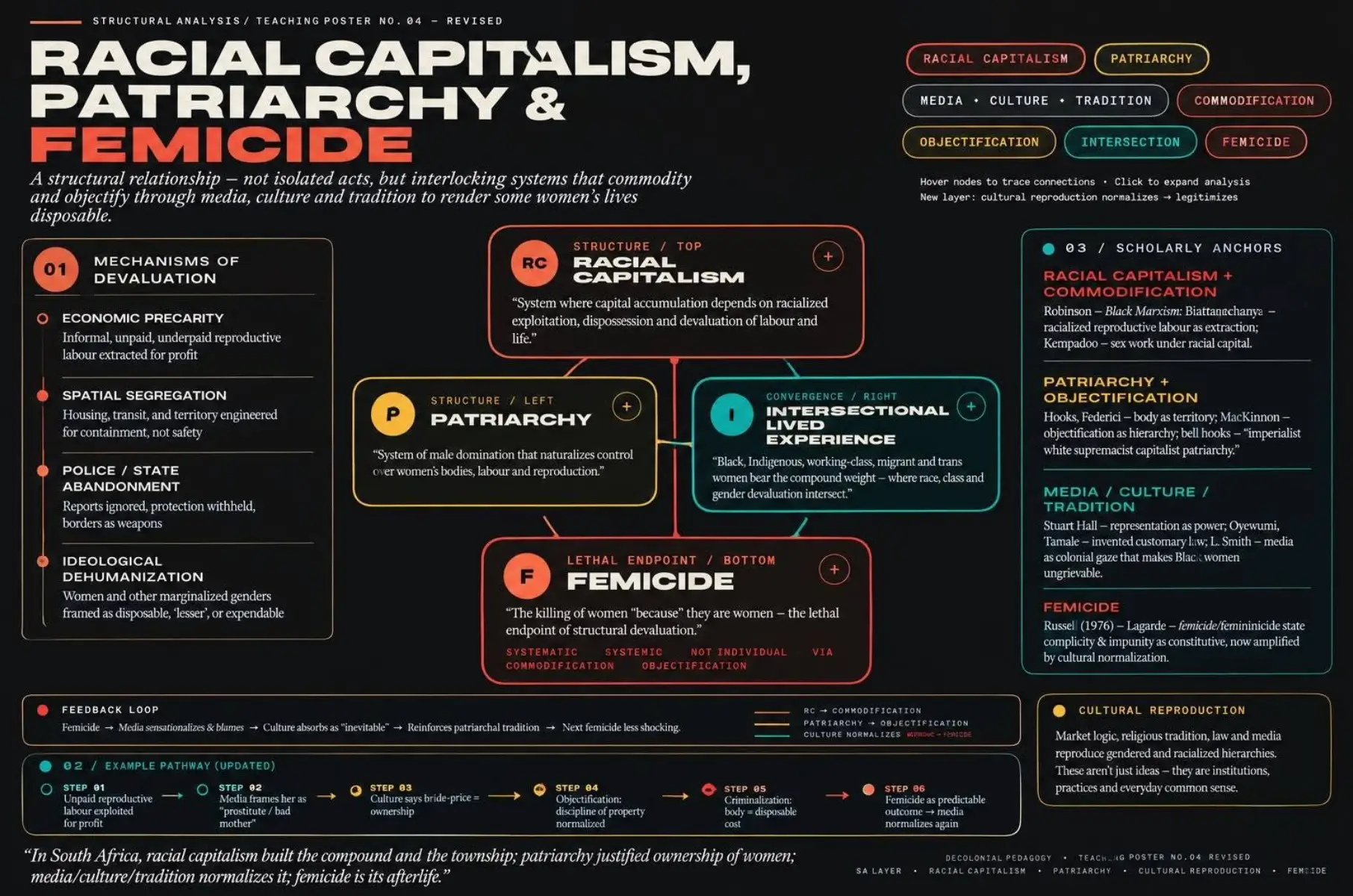
How to read the poster by Prof Salim Vally
The poster illustrates femicide not as an isolated crime, but as the systemic endpoint of two interlocking systems:
- Racial Capitalism
- Devaluation of Black, Indigenous and working-class women’s labour (paid and unpaid reproductive labour)
- Spatial segregation and precarious housing/work/transport
- State abandonment — police inaction, lack of shelters, justice impunity, lack of and unsafe recreation.
- Patriarchy
- Commodifying bodies, sexuality and reproduction
- Economic dependency through wage gap and unpaid care work
- Ideology of entitlement and punishment for autonomy.
Commodification and objectification of women’s bodies. The socialising role of media, religion, education, culture generally and “tradition”.
Violent Masculinity.
Heteronormativity.
Where they meet: The intersection is where vulnerability becomes fatal. Racial capitalism determines whose lives are rendered disposable and unprotected; patriarchy provides the rationale and means for controlling and destroying those lives.
Femicide = Economic disposability + Patriarchal entitlement + State impunity
The side panel traces a concrete pathway:
Unpaid labour exploited for profit → economic dependency → inability to leave violent household/workplace → normalization of violence → murder + lack of accountability
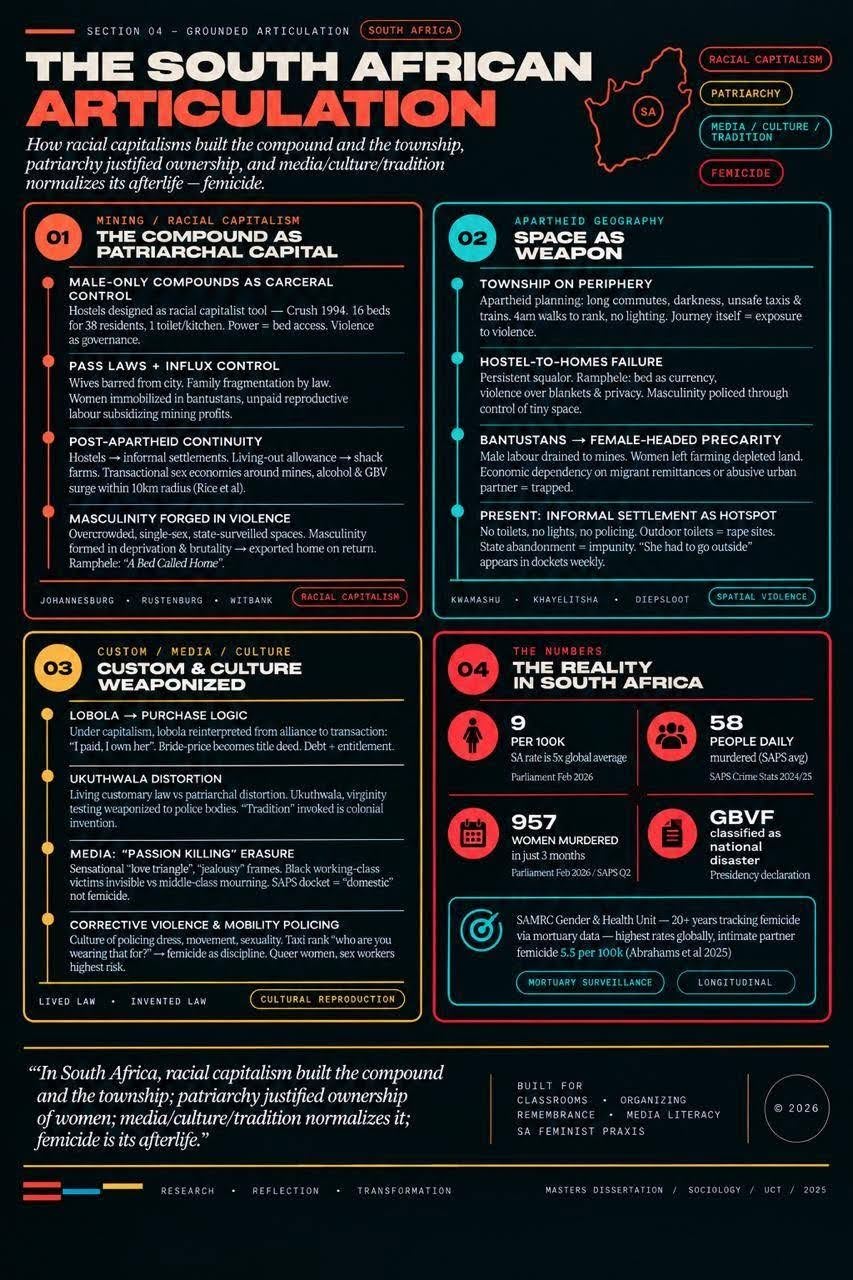
The South African Articulation:
- The Compound as Patriarchal Capital
The mining compound was racial capitalism in concrete form — carceral, single-sex, controlled entry/exit. Pass laws ensured women stayed in bantustans, doing unpaid reproductive labour that subsidised mining profit. Power in hostels was literally access to a bed — legally restricted to males — so space determined race, class, gender and age. Post-1994, Hostel-to-Homes never fully transformed them, and today the 10km radius around mines shows spikes in alcohol abuse, teenage pregnancy, and GBV.
- Space as Weapon
Apartheid geography was not accidental — townships on the periphery meant dangerous commutes, darkness, and no lighting or toilets in informal settlements. The bantustan system created structurally precarious female-headed households dependent on remittances. Those spaces remain femicide hotspots because the state still abandons them.
- Custom Weaponised
- Lobola under capitalism reinterpreted as purchase: “I paid, therefore I own”
- Ukuthwala distorted from negotiation to abduction
- Media framing: femicide as “passion killing” or “love triangle” — erasing structure, blaming victims, and making Black working-class victims invisible.
The current crisis in numbers:
- 9 per 100,000 women — 5x global average, Parliament Feb 2026
- Every 3 hours a woman is murdered, with 58 murders daily overall
- 957 women murdered July-Sept 2024 alone in 3 months
- November 2025: GBVF declared a National Disaster
- SAMRC’s 20+ year mortuary surveillance shows intimate partner femicide at 5.5 per 100k — 5x global
In South Africa, racial capitalism built the compound and the township; patriarchy justified ownership of women; media/culture/tradition normalises it; femicide is its afterlife.
I generally don’t use AI but this is an emergency and I find some of the “analysis” in the legacy, mainstream and social media sloppy, shoddy and sometimes appalling. The latter includes the dangerous opportunism of ‘March and March’ and their acolytes blaming “illegal foreigners” for femicide.