What if the Ceuta migration crisis was not only a humanitarian tragedy and border-security failure, but also an attempt to pressure Spain’s progressive, pro-Palestinian government? Some commentators argue that misleading online reports and intervention by Morocco, Israel, the United States or other forces helped drive tens of thousands of people towards Spain’s enclave.
Harsha Walia warns though that anti-imperialist analysis must not erase migrant agency or reproduce the far-right language of “invasion”. Online misinformation played a role: reports misrepresented a Spanish Supreme Court ruling on migrants intercepted at sea, creating the impression that reaching Ceuta by swimming would guarantee entry or residence.
Ceuta’s political message
The mass movement into Ceuta in late July 2026 has been widely described as a migration crisis. But for some progressive commentators, it represents something more: a possible attempt to destabilise or punish Spain’s relatively progressive government because of its increasingly critical position towards Israel and the United States.
Spain recognised the State of Palestine in 2024 and Prime Minister Pedro Sánchez has been one of Europe’s most vocal critics of Israel’s war in Gaza. Recent reporting also describes tensions between Madrid, Washington and Tel Aviv, including Spain’s refusal to facilitate certain US military operations.
From this perspective, the sudden crossing of tens of thousands of people into Ceuta could be interpreted as a form of coercive diplomacy. The argument is that Morocco, or actors aligned with Morocco, may have deliberately tolerated or encouraged the movement, while Israel, the United States or other forces could exploit the resulting crisis to weaken Madrid politically, strengthen Europe’s security response and undermine Spain’s independent foreign-policy position.
This interpretation cannot simply be dismissed. Morocco has previously used control over migration flows as leverage in disputes with Spain. In May 2021, approximately 8,000 people entered Ceuta after Moroccan authorities appeared to relax border controls during a diplomatic crisis triggered by Spain’s decision to provide medical treatment to Brahim Ghali, leader of the Polisario Front.
The available evidence confirms that misinformation circulated online, that migration routes through Ceuta were already active and dangerous, and that Morocco and Spain have deep political tensions over territory and Western Sahara.
Misinformation and migrant agency
Migration expert and organiser Harsha Walia places herself clearly within anti-imperialist, anti-colonial and migrant justice movements. As she writes:
“If you know any of my work, especially on the ground, you know that I am an anti-imperialist.”
She also warns against interpretations that erase migrants’ agency:
“Across state & imperial geopolitics, migrants do have some degree of agency.”
That agency is essential to understanding what happened in Ceuta.
There is strong evidence that misleading reports contributed to the movement. Spanish and international media reported that social-media posts misrepresented a Spanish Supreme Court ruling concerning migrants intercepted at sea. The ruling restricted the use of immediate pushbacks in certain circumstances; it did not grant migrants an automatic right to remain in Spain or travel to mainland Europe.
Reuters described “misleading information online” suggesting that people arriving by sea would be allowed to stay in Spain. Other reporting found that videos and messages circulated on TikTok, WhatsApp, Facebook and Instagram, creating the impression that Ceuta had become an “open gate”.
This misinformation may have been spread by smugglers, opportunistic accounts, political actors or ordinary users misunderstanding the ruling. The precise sources and coordination remain matters for investigation.
But a misleading message does not mean the people who responded were imaginary participants in a foreign operation. People made decisions based on information they believed to be true, often under conditions of economic hardship, displacement and restricted mobility.
Walia challenges the fixation on the fact that many of those who crossed were young men. She notes that young men have made up a significant proportion of people using western migration routes for many years. That demographic pattern reflects the physical dangers, costs and demands of migration journeys; it does not prove military mobilisation.
As Walia puts it, narratives focused on “military-aged men” can reproduce the same language used by far-right anti-migrant movements in Europe.
More importantly, such narratives conceal those who died.
At least 67 people were reported dead after the late-July crossings, with later estimates rising as bodies were recovered and identified. Human Rights Watch described the arrival of between 50,000 and 60,000 people as “not only unprecedented but tragic”
The dead were not a geopolitical abstraction. They were people who drowned, were crushed or became separated from their families while trying to reach the enclave.
Fortress Europe
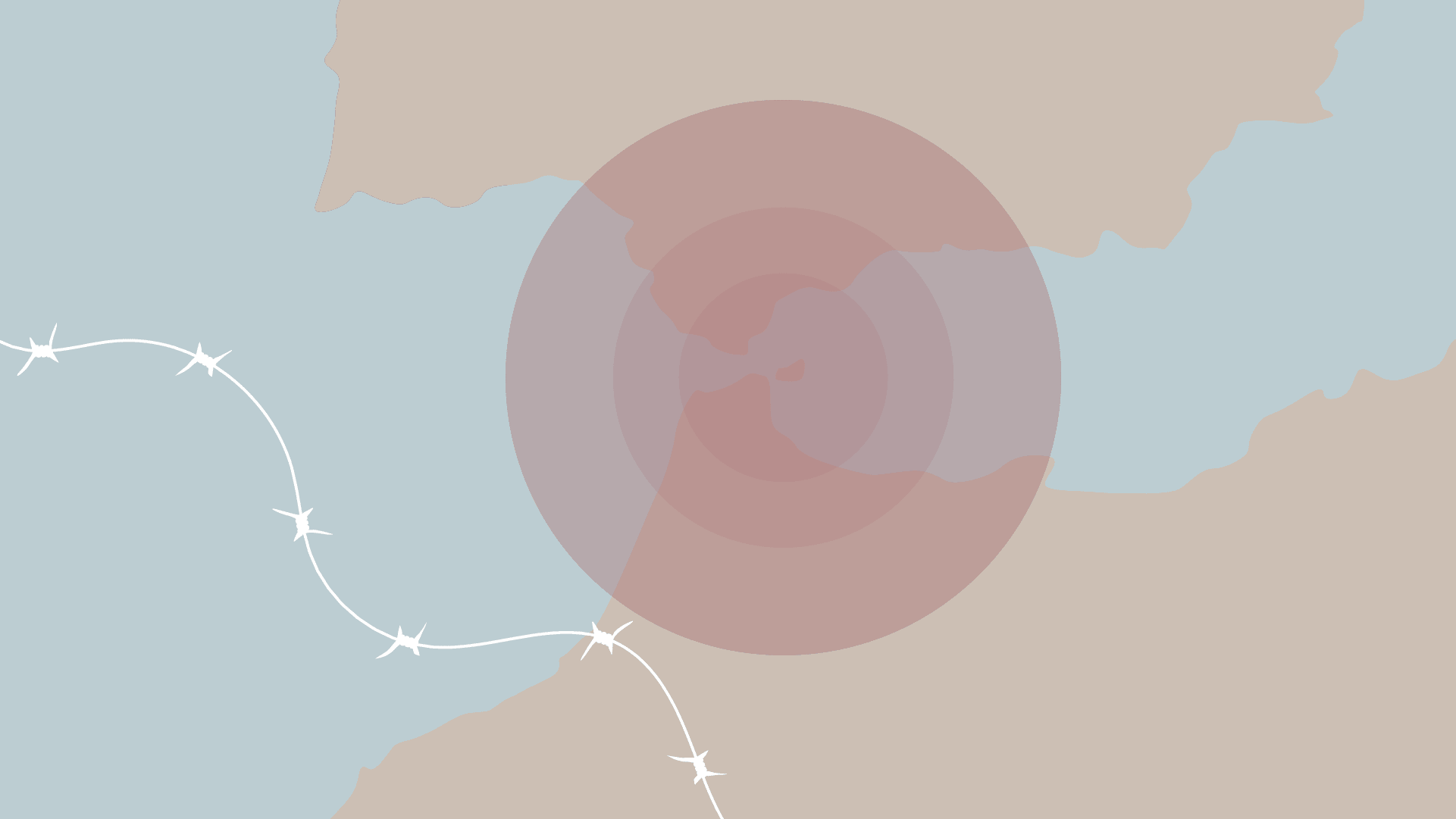
Ceuta is a Spanish-administered city on the North African coast, surrounded by Morocco. Alongside Melilla, it forms the European Union’s only land border with Africa. Morocco disputes Spanish sovereignty over both enclaves and has long demanded their return.
The territories are therefore shaped by overlapping histories: Spanish imperial expansion, Moroccan territorial claims, European border policy and local questions of identity and belonging.
Since the 1990s, Spain and the EU have progressively militarised the borders around Ceuta and Melilla. Fences, surveillance systems, drones, patrol boats and border-control operations have been expanded to prevent people from reaching European territory.
This system is part of what migrant justice movements call Fortress Europe: a border regime that seeks to keep migrants outside Europe by moving immigration enforcement into neighbouring countries.
The European Union has funded Moroccan border-security operations, while Frontex has supported Spanish surveillance and maritime operations in the western Mediterranean and Atlantic routes.
The result is a system in which the EU externalises responsibility. European governments help finance border control in North Africa, but the violence and human-rights abuses associated with interception often occur outside direct European scrutiny.
When legal routes are closed, people are pushed towards more dangerous ones. They cross deserts, climb fences, swim around barriers or rely on smugglers. The danger is then used to justify even more militarisation.
This is why Walia rejects the idea that the answer to Ceuta is simply for Moroccan authorities to “do their jobs” by stopping migrants. The question must be: what will the expanded security apparatus do to people in the months and years ahead?
Morocco, Western Sahara and Israel
Morocco’s possible role deserves close scrutiny.
Rabat has cooperated extensively with Spain and the EU on migration control, while also using its control over movement towards Ceuta and Melilla as a source of diplomatic leverage. In 2021, the apparent relaxation of Moroccan border controls produced a major influx into Ceuta and was widely interpreted as retaliation for Spain’s treatment of Brahim Ghali.
The 2026 crisis therefore cannot be detached from the history of Spain–Morocco relations.
It is also inseparable from Western Sahara. Morocco claims sovereignty over the disputed territory, while the Polisario Front demands self-determination for the Sahrawi people. Spain’s position shifted in 2022, when Sánchez’s government endorsed Morocco’s autonomy proposal as the “most serious, realistic and credible” basis for resolving the conflict.
That decision improved relations with Morocco but damaged Spain’s relationship with Algeria, which supports the Polisario Front. It also marked a retreat from Spain’s previous support for a UN-backed process centred on Sahrawi self-determination.
For Walia, Western Sahara must not be treated merely as a tool for explaining US or Israeli power. It is a struggle with its own history and political meaning.
Morocco normalised relations with Israel in 2020 as part of a deal that included US recognition of Moroccan sovereignty claims over Western Sahara.
That relationship creates obvious geopolitical connections. Israel and Morocco have expanded security and technology cooperation. Washington regards Morocco as an important regional partner. Spain’s opposition to Israel’s war in Gaza has made Madrid a more distinct and sometimes isolated voice in Europe.
The danger of a single explanation
The temptation during a dramatic crisis is to search for one hidden actor responsible for everything.
For some progressive accounts, the story is straightforward: Israel and the United States are retaliating against Spain’s pro-Palestinian foreign policy, using Morocco and migrants to create a crisis at Europe’s border.
This explanation has political appeal because it places the event within a recognisable structure of imperial power. But it also risks simplifying a complex situation and depriving migrants of their own political agency.
Walia’s intervention is a warning against that reduction. She writes that theories portraying migrants as instruments of foreign intervention can “fortify the argument that irregular migration is unwanted and is, in fact, an ‘invasion’”.
That is the danger. A narrative intended to expose imperial manipulation can end up validating the militarisation of borders. It can encourage support for more barriers, more drones, more troops and more interceptions—not only in Ceuta, but across Europe’s external borders.
The consequences will fall on migrants, refugees, racialised communities and people who assist them.
A critical analysis must therefore separate three questions:
- What caused people to move? Misinformation, economic hardship, social-media campaigns, migration networks, border openings and individual decisions may all have played a role.
- Did states manipulate or exploit the movement? Morocco’s history of using border control as diplomatic leverage makes this a legitimate question. It requires evidence, not assumption.
- Who benefits from the crisis? European security agencies, far-right parties, border-technology companies and governments seeking greater control may all benefit, even if they did not cause the initial movement.
These questions can coexist. One does not cancel the others.
A migrant justice response
The Ceuta crisis should not lead progressive movements to defend Fortress Europe.
It should lead to demands for:
- An independent investigation into the deaths and missing people.
- Accountability for Spanish and Moroccan security forces.
- Access to asylum procedures and legal representation.
- Safe routes for people seeking protection.
- Transparency about the social-media campaigns and misinformation.
- Scrutiny of Morocco’s possible use of migration as diplomatic leverage.
- Respect for Palestinian and Sahrawi self-determination.
- An end to European funding for abusive border externalisation.
The crisis also requires a more honest understanding of the word “security”. Security for Europe cannot be built through the permanent insecurity of African and Middle Eastern migrants.
Spain’s government may have a more progressive position on Palestine than many European governments. It may face pressure from Israel, the United States, Morocco and the European far right. Those realities deserve attention.
But the lives of migrants must not be turned into evidence in a geopolitical argument. Their suffering is not a convenient metaphor for imperialism. Nor should their movement be used to justify the security apparatus that has made migration so deadly.
Ceuta is simultaneously a site of colonial history, contested sovereignty, geopolitical rivalry, disinformation and human desperation.
A responsible progressive response must hold all of these realities together.
It must investigate state manipulation without denying migrant agency. It must oppose Israel and US imperialism without inventing facts. It must defend Western Sahara without reducing Sahrawi self-determination to a footnote. And it must challenge Spain and the EU without reproducing the language of invasion.
As Walia’s intervention makes clear, the task is not to choose between anti-imperialism and migrant justice.
The task is to practise both.
References
- Harsha Walia, “On Ceuta” — original statement.
- Reuters, “Social Media Rumours, Economic Hardship Fuel Migrant Surge into Ceuta”, 31 July 2026.
- Reuters, “The Viral Videos That Inspired Tens of Thousands to Swim towards Spain’s Ceuta”, 4 August 2026.
- Euronews, “How Misleading Information Spread during the Ceuta Crisis”, 4 August 2026.
- BBC News, “How Spain’s Migrant Crisis Created a Political Storm”, 2 August 2026.
- NPR, “Death Toll from Spain Border Crisis Reaches 67 as Tens of Thousands Cross Back”, 1 August 2026.
- Human Rights Watch, “Rapid Returns Follow Migrant Crossings to Ceuta”, 3 August 2026.
- Associated Press, “Ceuta Returns to Calm as Most Migrants Leave Spanish Enclave”, 2 August 2026.
- Associated Press, “Spain Installs Sea Barrier on Ceuta’s Border with Morocco”, 1 August 2026.
- Reuters, “EU Ministers Seek Tougher Migration Response after Ceuta Influx”, 4 August 2026.
- Reuters, “Spain Rejects Discussing Sovereignty of Enclaves with Morocco”, 12 August 2026.
- Le Monde, “How Morocco Is Pressuring the Spanish Enclaves of Ceuta and Melilla”, 4 August 2026.
- The Guardian, “Spain’s Pedro Sánchez Is a Progressive Outlier in Europe—and over Ceuta, He Is Being Made to Pay for It”, 6 August 2026.
- Al Jazeera, “Is Spain Being Punished?”, 1 August 2026.
- Al Jazeera, “Why Did Ceuta Migrant Mayhem Chill Already Frosty Israel–Spain Relations?”, 1 August 2026.
- Associated Press, “Fact Focus: Migrant Crossing in Spain’s Ceuta Breeds Unsubstantiated Claims”, 31 July 2026.
- Statewatch, “Aid, Border Security and EU–Morocco Cooperation on Migration Control”.
- Asylum Information Database, “Access to the Territory and Pushbacks: Spain”, updated 8 May 2026.
- Middle East Institute, “The Abraham Accords”, updated 7 January 2026.
- BBC News, “Morocco’s Western Sahara Claim and the Abraham Accords”, 3 August 2026.