Image source: https://agroecology-coalition.org/organic-cotton/
Cotton is often called Benin’s “white gold.” It is a crop that carries the weight of export earnings, rural livelihoods and national ambitions. But for many women, it has also carried a familiar burden: long hours in the fields, exposure to hazardous chemicals, and little control over the land, inputs or money their labour produces.
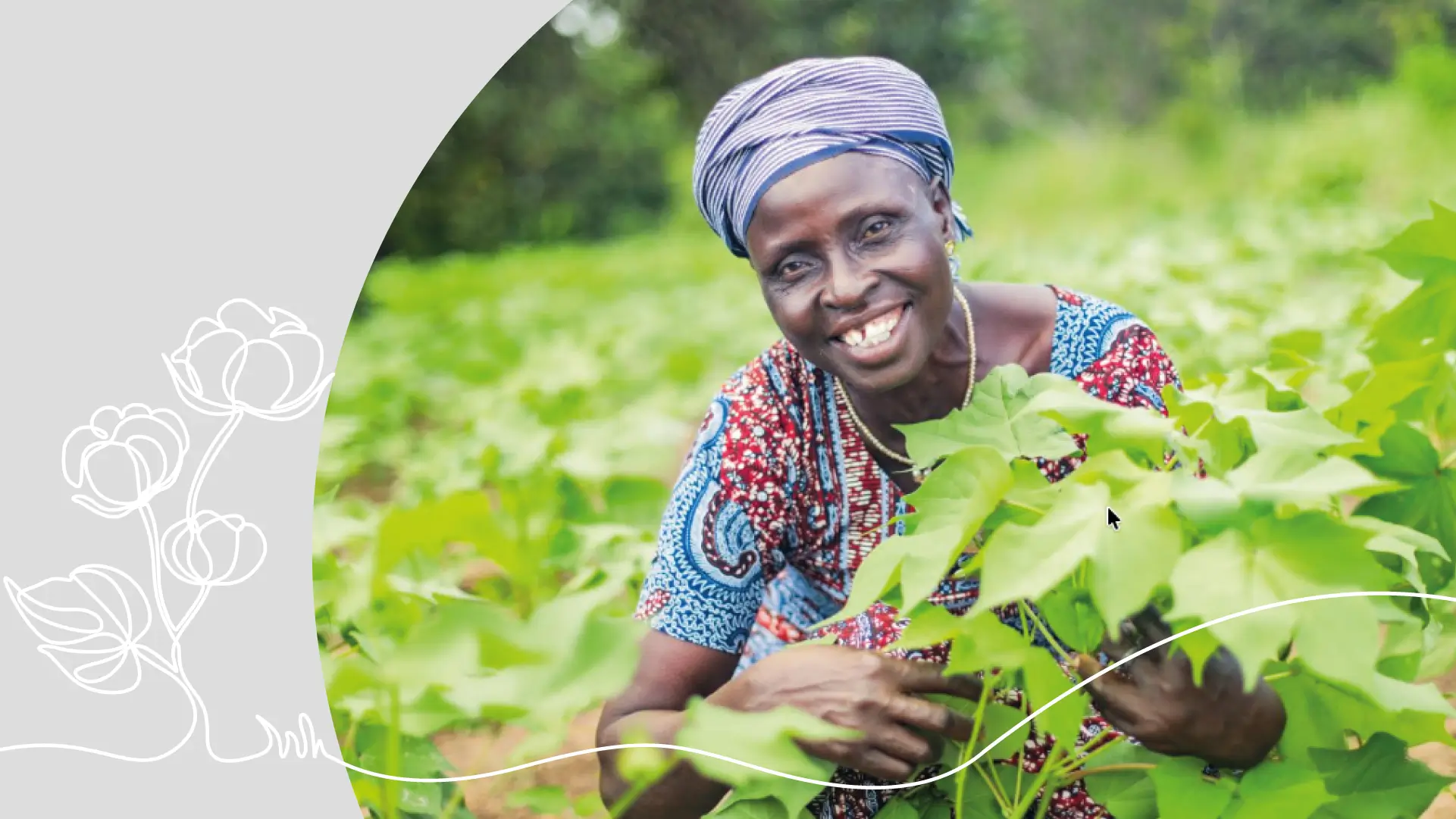
That is beginning to change. Across parts of central Benin, women are becoming organic-cotton farmers in their own right. They are growing certified cotton without synthetic pesticides, earning income directly, managing money, accessing land and taking part in cooperative decisions. The change is neither automatic nor complete. But it is visible in the lives of women such as Béatrice Goun, Élisabeth Degbohoue, Evelyn Atekokale and Alougba.
From labour to ownership
Cotton has been central to Benin’s rural economy for decades. It is the country’s main export crop, and much of its fibre has historically left Benin as a raw commodity rather than being processed into cloth at home. Cotton supports a vast network of smallholder producers, cooperatives, traders and textile workers. In a country of just over 15 million people, the sector is estimated to sustain more than two million rural livelihoods directly or indirectly.
Yet the conventional model has often reproduced gender inequality. Women have been heavily involved in sowing, weeding, harvesting and feeding workers during the farming season, but men have more often controlled land, inputs and cooperative leadership. In some village producer organisations, women were under-represented on decision-making bodies. In certain contexts, they were not even entitled to membership.
Organic cotton offers a different entry point. By relying on compost, manure, crop rotation and locally available botanical pest controls, it can reduce dependence on expensive and hazardous agrochemicals. For women, that can mean a route into cash-crop production without having to negotiate access to male-controlled input systems.
Béatrice’s choice
In Didja, Béatrice Goun made a decision shaped by fear for her children. She did not want to grow conventional cotton because of the chemical inputs used in production.
“I never wanted to grow cotton because of the chemical inputs,” she said. “They’re too dangerous, especially for children.”
Organic farming changed the terms of her participation. Goun learned how to restore soil fertility and rotate crops, while avoiding the synthetic chemicals that had made conventional cotton feel unsafe.
The income mattered too. With money earned from organic cotton, Goun paid for her daughter’s sewing apprenticeship and bought her a sewing machine. In a country where cotton has long been framed as a male cash crop, that is a quiet reversal: a mother using cotton income to equip her daughter with a trade.
Goun also describes a change in everyday power. “Before, I had to wait for my husband to do everything,” she said. “But now it’s different. I can read and count money. And I manage my own money. I can make my own decisions.”
Her story is not simply about higher yields. It is about literacy, financial control and the ability to imagine a future beyond the limits set by someone else.
Land changes the equation
In Aklampa, in the central commune of Glazoué, Élisabeth Degbohoue and her husband Paul Leode have farmed for more than 15 years. They grow cotton in rotation with pigeon peas, peanuts, sesame and cassava, using organic methods to avoid chemical inputs.
Degbohoue’s experience highlights the issue that sits beneath many women’s economic struggles: land. With support from OBEPAB, the Beninese Organisation for the Promotion of Organic Agriculture, she obtained good land from her husband for her own production.
“Thanks to the production of organic cotton and the support I get from OBEPAB, my husband has given me good land for my own production,” Degbohoue said.
Better land brought better yields and direct revenue. For Degbohoue, that translated into greater financial independence. It also illustrates why land access cannot be treated as a technical farming issue alone: it is a question of who can produce, earn, save and decide.
OBEPAB’s approach has included “School for Husbands” workshops, where men and women discuss how to improve women’s access to fertile land. That matters because women’s autonomy cannot be achieved through training alone if men continue to control the most productive resources.
Degbohoue now sees organic cotton as part of a wider community future. She hopes its benefits will spread to family and friends, increasing the number of organic producers, while additional income helps build wells, shops and access to markets.
Paid directly, deciding directly
Nearby, Evelyn Atekokale offers perhaps the clearest explanation of why direct payment matters. An organic-cotton producer in Glazoué, she says organic cotton gave her more independence.
“Organic cotton has given me more independence as a woman, because I receive a better income, and I am paid immediately after the harvest,” Atekokale said.
The significance is easy to overlook. A woman may work throughout a season, but if the payment passes first through a husband, father or male cooperative official, her labour may not translate into economic power. Direct payment interrupts that chain.
Atekokale says the income allows her to buy goods she previously could not afford. More importantly, she says her children’s health is no longer at risk. Her words connect two forms of security that are often treated separately: economic independence and protection from pesticide exposure.
Alougba’s house
In Aklampa, Alougba, a widow in her sixties, shows what cotton income can mean when a woman is carrying a household alone. After her husband died, money from cotton helped finance her son’s university education.
She later used this income to build a two-room house where she lives with her son, who temporarily joined her for agricultural work, and her daughter-in-law. Her story is a reminder that women’s economic autonomy is not only about individual consumption or business ownership. It can mean housing security, the ability to support children’s education, and resilience after loss.
Alougba also challenges the idea that cotton is naturally a man’s crop. “Organic cotton should also be a women’s affair,” she said, demonstrating that women are claiming a place within the productive and decision-making core of a typically male-dominated industry..
A collective shift
These individual stories reflect a wider pattern. The Growing Benin’s Organic Cotton Sector initiative has supported 9,470 farmers, with women representing about 30% of participants: roughly three times their share in conventional cotton farming in the areas concerned. It has also supported 181 women cooperative leaders and recorded a 40% increase in the proportion of women with partial control over household income.
The programme combines organic farming training with literacy, numeracy, cooperative management and leadership development. Women are learning how to read accounts, participate in meetings, manage money and lead.
The model also has environmental logic. Organic farmers rotate cotton with food crops, avoid synthetic chemical inputs and build soil health through practices such as composting and manure use. That can improve food security while reducing exposure to hazardous pesticides.
Cotton’s next chapter
Benin is now trying to capture more value from its cotton at home. The government announced a ban on raw cotton exports in 2025, requiring cotton to be processed domestically before export. The ambition is to build a local textile industry – spinning, weaving, dyeing and garment-making – rather than exporting raw fibre alone.
For women, this could extend the possibilities beyond the field. In Ouidah, the textile company Couleur Indigo has received support to develop indigo-dyed fabric production, and women make up a significant share of its workforce. Elsewhere, entrepreneur Mariam Dosso’s DAF Collection employs about a dozen women weavers; one weaver, Chabi Baké, earns roughly $545 a month and is using her income to build a family home.
The challenge now is to ensure that local processing creates decent work, fair pay and ownership opportunities for women.
Not a finished victory
Benin’s organic-cotton movement is not a completed feminist transformation. Women still face unequal access to land, social expectations, limited representation in conventional cotton structures and dependence on certification systems and international markets.
But Goun, Degbohoue, Atekokale and Alougba show what change can look like when it begins with women’s own priorities: safe work, fertile land, direct income, literacy, cooperative leadership and a future for their children.
References
- Agroecology Coalition, “Growing Benin’s Organic Cotton Sector.” https://agroecology-coalition.org/organic-cotton/
- Textile Exchange, “Empowering Cotton Communities in Aklampa, Benin,” 26 March 2024. https://textileexchange.org/organic-farming-aklampa-benin-obepab-panuk/
- PAN UK, “A new era for organic cotton in Benin,” 7 October 2024. https://www.pan-uk.org/a-new-era-for-organic-cotton-in-benin/
- Associated Press, “Benin bets on turning its cotton crop into clothes at home,” 13 September 2026. https://apnews.com/article/benin-cotton-producer-garments-economy-hope-ecbe1fde7244e1530bc9403d7c26f86c
- European Investment Bank, “EU Global Gateway strategy: EIB and BIIC strengthen strategic agricultural value chains for benefit of Benin and Europe,” 14 July 2026. https://www.eib.org/en/press/all/2026-252-eu-global-gateway-strategy-eib-and-biic-strengthen-strategic-agricultural-value-chains-for-benefit-of-benin-and-europe
- PAN North America, “Organic cotton & increased yields in West Africa,” 17 January 2023. https://www.panna.org/news/organic-cotton-increased-yields-in-west-africa/
- PAN Germany, “Culture du coton biologique et cultures vivrières au Bénin: le rôle de l’OBEPAB.” http://www.pan-germany.org/download/cotton/obepab%20leaflet_FR.pdf
- Growing Culture and Cotton Diaries, Stories from the Ground, Aklampa, Benin. https://www.agrowingculture.org/wp-content/uploads/2024/02/Stories-From-the-Ground-Booklet-Spreads-17.1-MB-1.pdfagrowingculture
- Louis Bolk Institute, “Benin Organic Cotton project.” https://www.louisbolk.nl/sites/default/files/publication/pdf/2131.pdf
- PAN UK, “Cotton in Benin,” 26 August 2025. https://www.pan-uk.org/cotton-in-benin/
- GIZ, “Organic cotton from Benin: green, fair and inclusive,” 13 March 2025. https://www.giz.de/en/newsroom/news/organic-cotton-benin-green-fair-and-inclusive
- Omiren Styles, “Cotton as Identity: How Benin’s ‘White Gold’ Shaped Its…,” 23 June 2026. https://omirenstyles.com/benin-cotton-fashion-identity/